U.S. passport photo requirements
U.S. passport photo requirements explained in detail
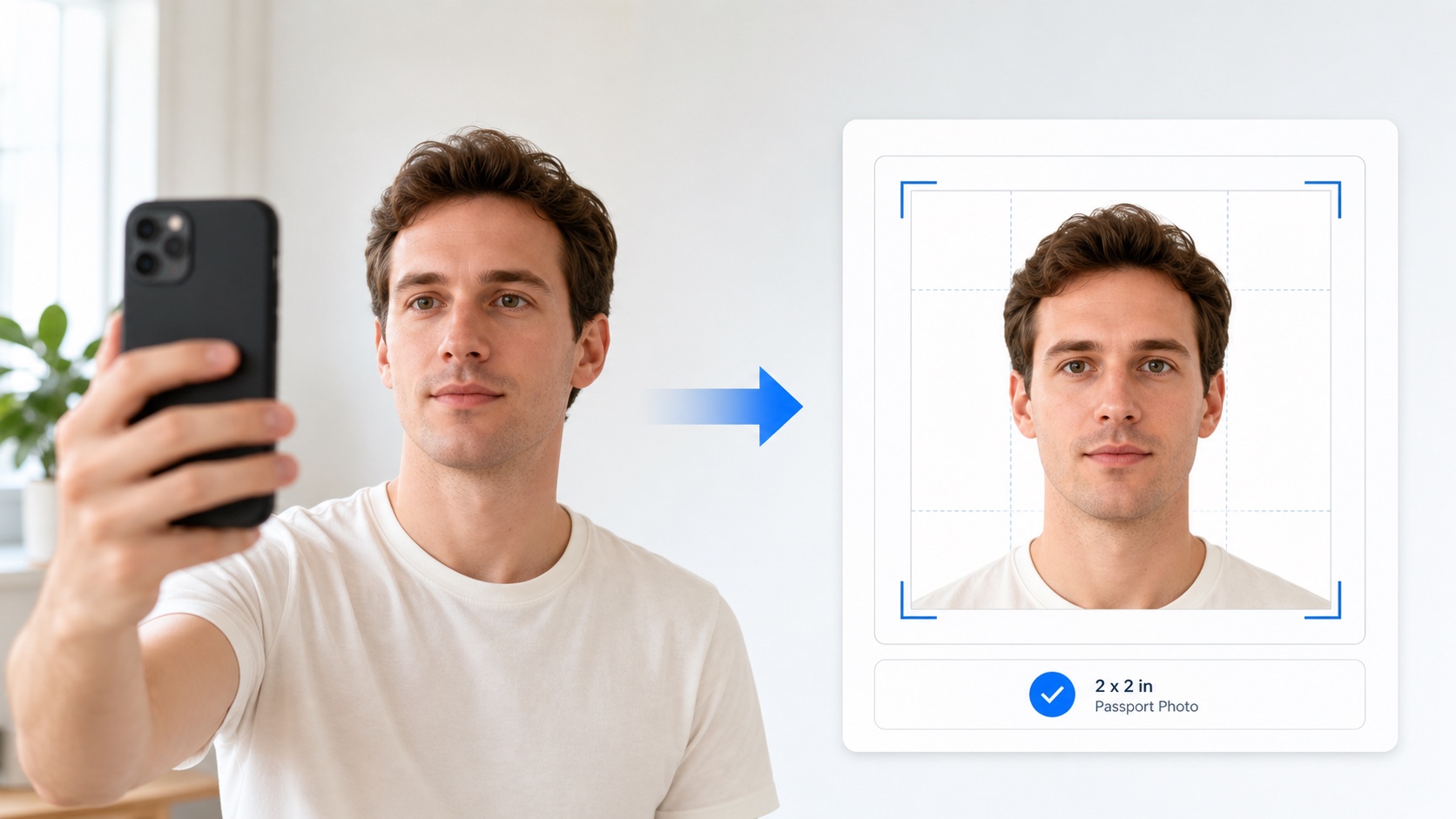
A U.S. passport photo looks simple, but small details can cause delays: the file must be the right 2 x 2 inch size, the head must be correctly framed, the background must be plain, and nothing should hide or alter your face. This guide explains the official rules and shows what to check before you submit your passport application.
Printed size
2 x 2 in
Required for paper passport applications.
Head height
1 to 1 3/8 in
Measured from chin to top of head.
Background
White or off-white
Plain, clean, and shadow-free.
Digital square
600-1200 px
For official digital composition ranges.
Size and composition
1. U.S. passport photo size is 2 x 2 inches
For a paper passport application, the printed photo must be exactly 2 x 2 inches, or 51 x 51 mm. The head should be centered in the square frame and measured from the bottom of the chin to the top of the head, including hair. The official composition template places the head height between 1 inch and 1 3/8 inches, or 25 mm to 35 mm.
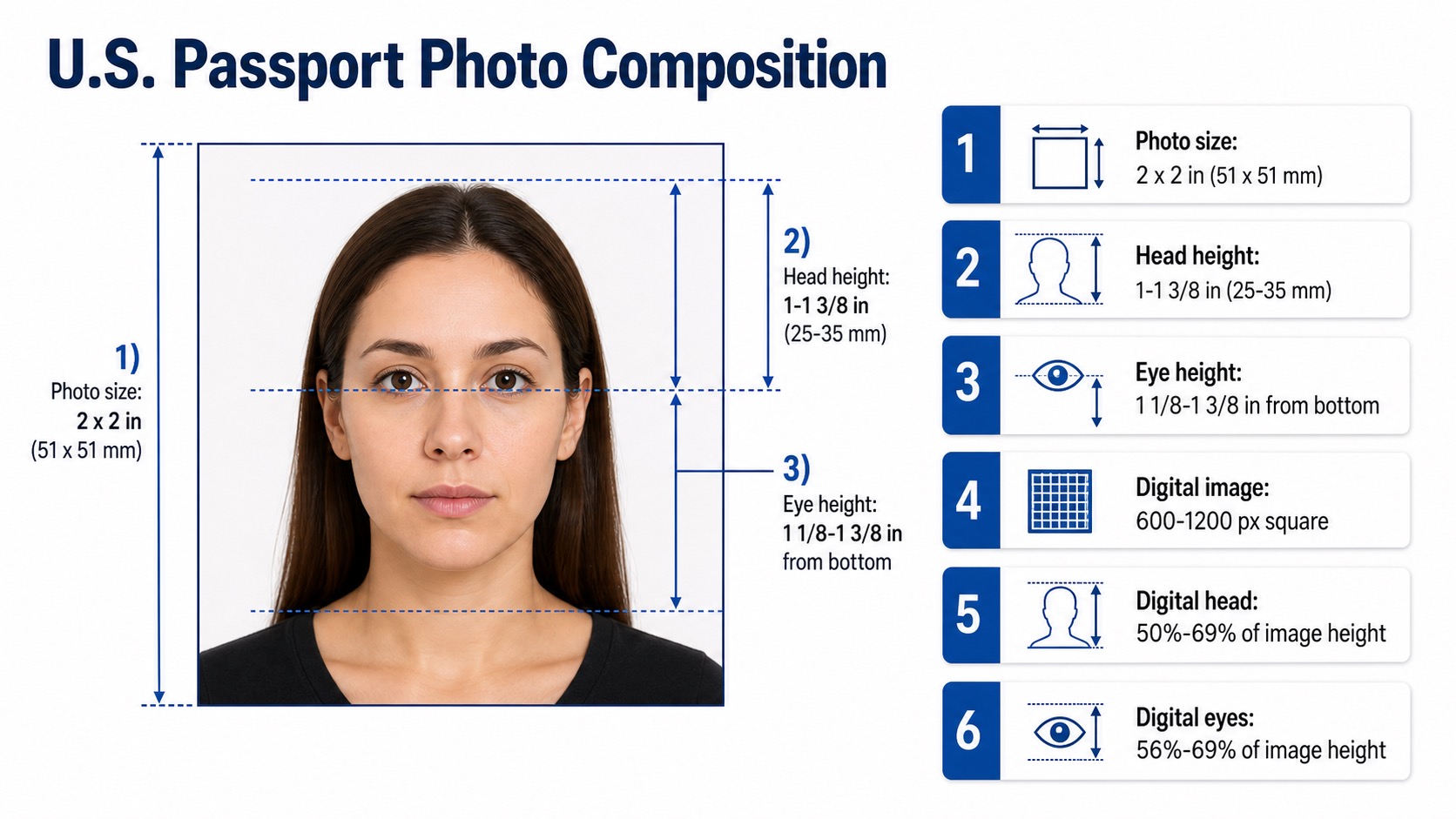
| Requirement | Official range | Why it matters |
|---|---|---|
| Printed photo size | 2 x 2 inches (51 x 51 mm) | The final passport photo is a square print. |
| Head size | 1 inch to 1 3/8 inches (25 mm to 35 mm) | Measure from the bottom of the chin to the top of the head, including hair. |
| Eye height on paper photo | 1 1/8 inches to 1 3/8 inches from bottom | The official template uses this range to keep the face naturally positioned. |
| Digital image dimensions | 600 x 600 px to 1200 x 1200 px | The official digital template requires a square image. |
| Digital head percentage | 50% to 69% of image height | The top of the head to the bottom of the chin should fall within this range. |
| Digital eye height | 56% to 69% of image height | Measured from the bottom of the image to the eye level. |
Background and lighting
2. Use a plain white or off-white background
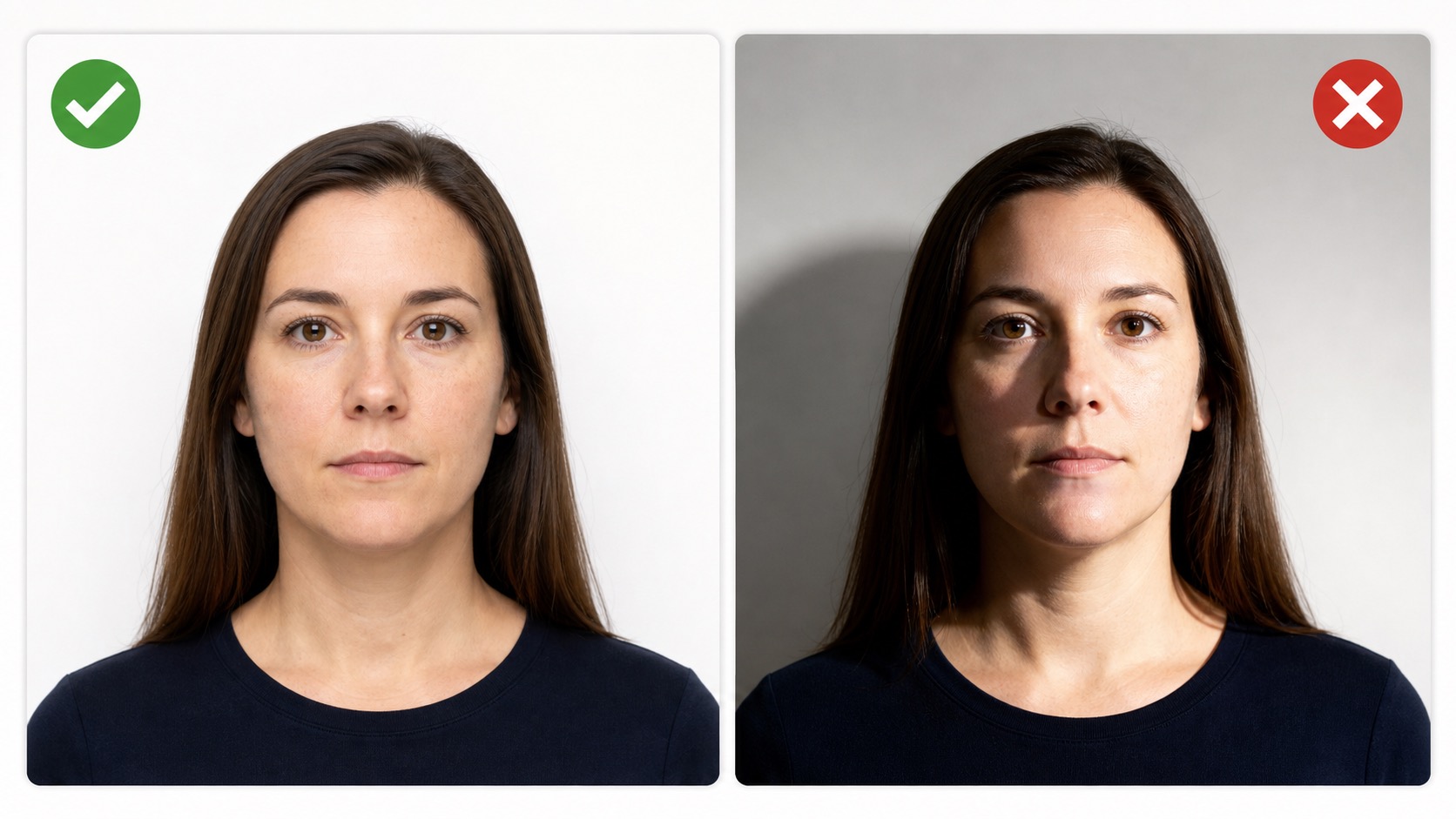
The background should be simple and distraction-free: white or off-white, with no texture, lines, objects, or visible shadows. Lighting should be even across the face and background. Side lighting, overhead lighting, harsh phone flash, and dim indoor lighting can create shadows or exposure problems that make the photo harder to accept.
Use a plain wall
Stand in front of a white or off-white wall without panels, patterns, furniture, or decorations.
Avoid shadows
Move away from the wall and use soft front lighting so the face and background stay evenly lit.
Keep exposure balanced
The photo should not be too bright, too dark, blurry, grainy, or heavily compressed.
Face, pose, and expression
3. Face the camera directly with both eyes open
Your passport photo must show a clear, current image of your full face. Look straight into the camera, keep your head level, and avoid tilting or turning. A neutral expression is safest, and a natural smile is only appropriate when your mouth remains closed and both eyes stay open.
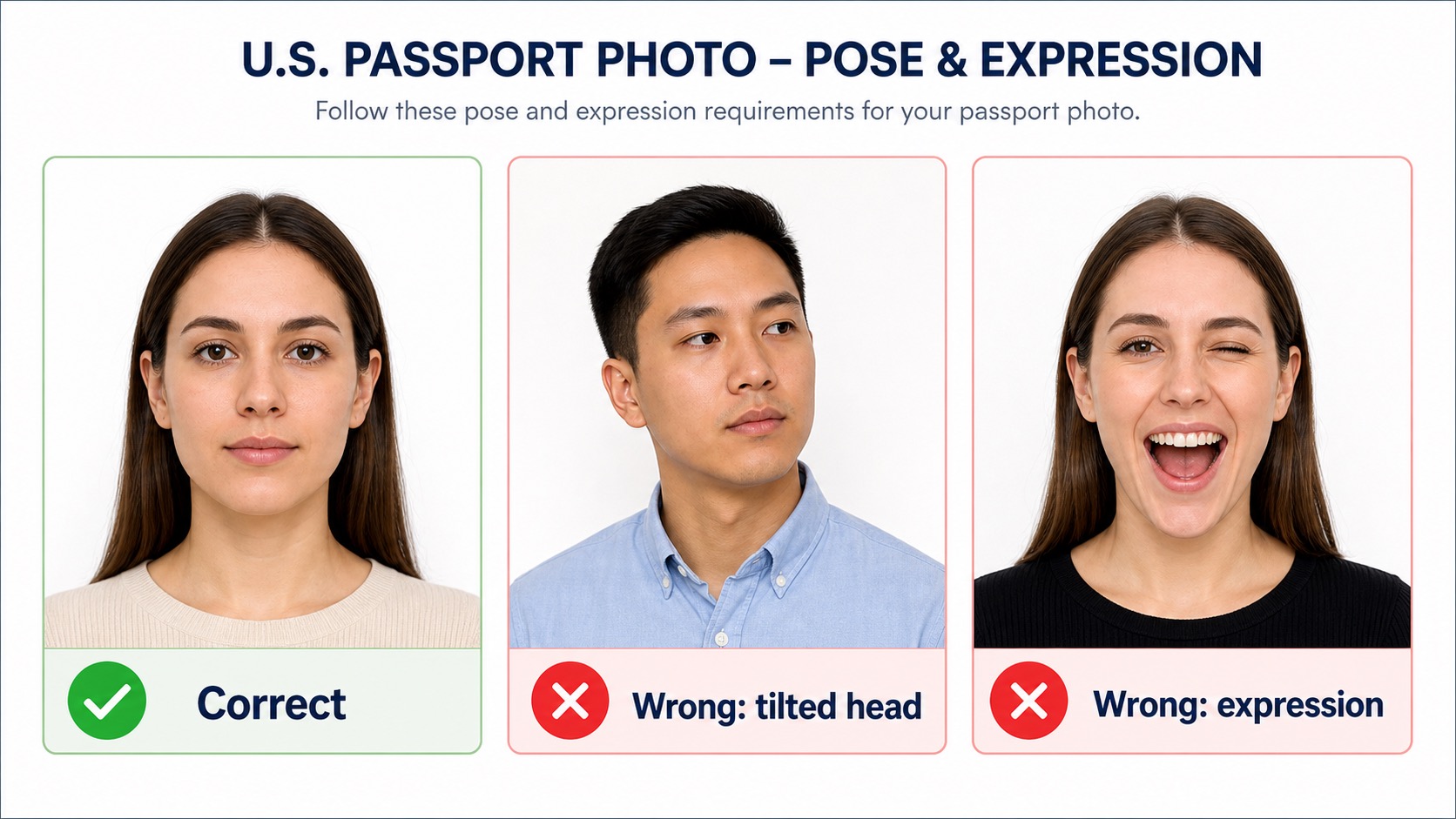
Full face in view
Face the camera directly with the full face visible. Do not rotate, tilt, or angle the head.
Eyes open, mouth closed
Keep both eyes open. A neutral expression is safest, and any natural smile should keep the mouth closed.
No face obstruction
Hair, shadows, glare, masks, hats, or accessories should not cover the eyes, nose, mouth, jawline, or face outline.
Recent appearance
Use a color photo taken within the last 6 months so it reflects your current appearance.
Clothing and accessories
4. Wear normal clothing and remove glasses
Everyday clothing works best. Avoid uniforms, clothing that looks like a uniform, camouflage patterns, headphones, wireless hands-free devices, face coverings, and anything that blocks part of the face. Eyeglasses should be removed unless a medical exception applies and the application includes a signed note from a doctor.
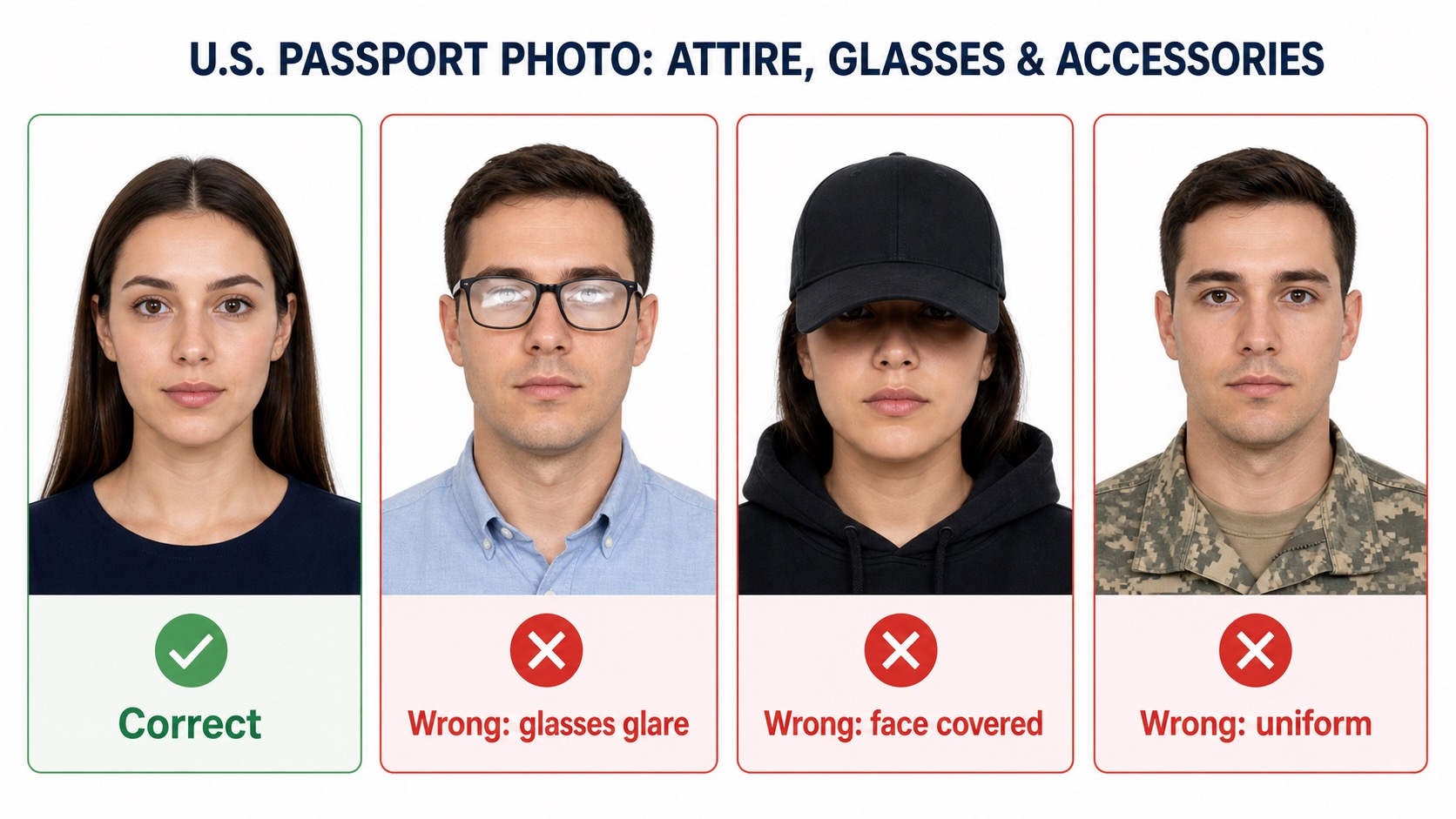
Everyday clothing is best
Wear normal clothing that does not look like a uniform. Avoid camouflage and uniform-like tops.
Remove eyewear
Take off eyeglasses, sunglasses, and tinted glasses unless you qualify for a medical exception.
Head coverings need an exception
Religious or medical head coverings may be allowed, but the full face must be visible and the covering should not cast shadows.
Jewelry is allowed if it is subtle
Jewelry and facial piercings are acceptable when they do not hide the face, create glare, or cast shadows.
Print and digital quality
5. Submit a high-resolution color photo
A passport photo should be sharp, color accurate, and free from blur, grain, pixelation, creases, holes, smudges, and scanning artifacts. For paper applications, print on matte or glossy photo-quality paper. For digital images that follow the official square template, use a square image between 600 x 600 pixels and 1200 x 1200 pixels.
Use a high-resolution color image
Do not submit blurry, grainy, pixelated, photocopied, or digitally scanned photos.
Print on photo-quality paper
For paper applications, use matte or glossy photo-quality paper and avoid holes, creases, smudges, or damaged prints.
Prepare without changing appearance
Sizing, cropping, and background preparation should preserve the natural face. Do not reshape, beautify, filter, or alter facial features.
Review before submitting
The final decision is made by the passport or visa authority, so check every requirement before you submit or mail the application.
Avoid rejection
Common U.S. passport photo mistakes
Many rejected photos fail for practical reasons: wrong head size, uneven lighting, glare, hidden facial features, non-plain backgrounds, or digital edits that change the applicant's appearance. Review these issues before downloading or printing the final file.
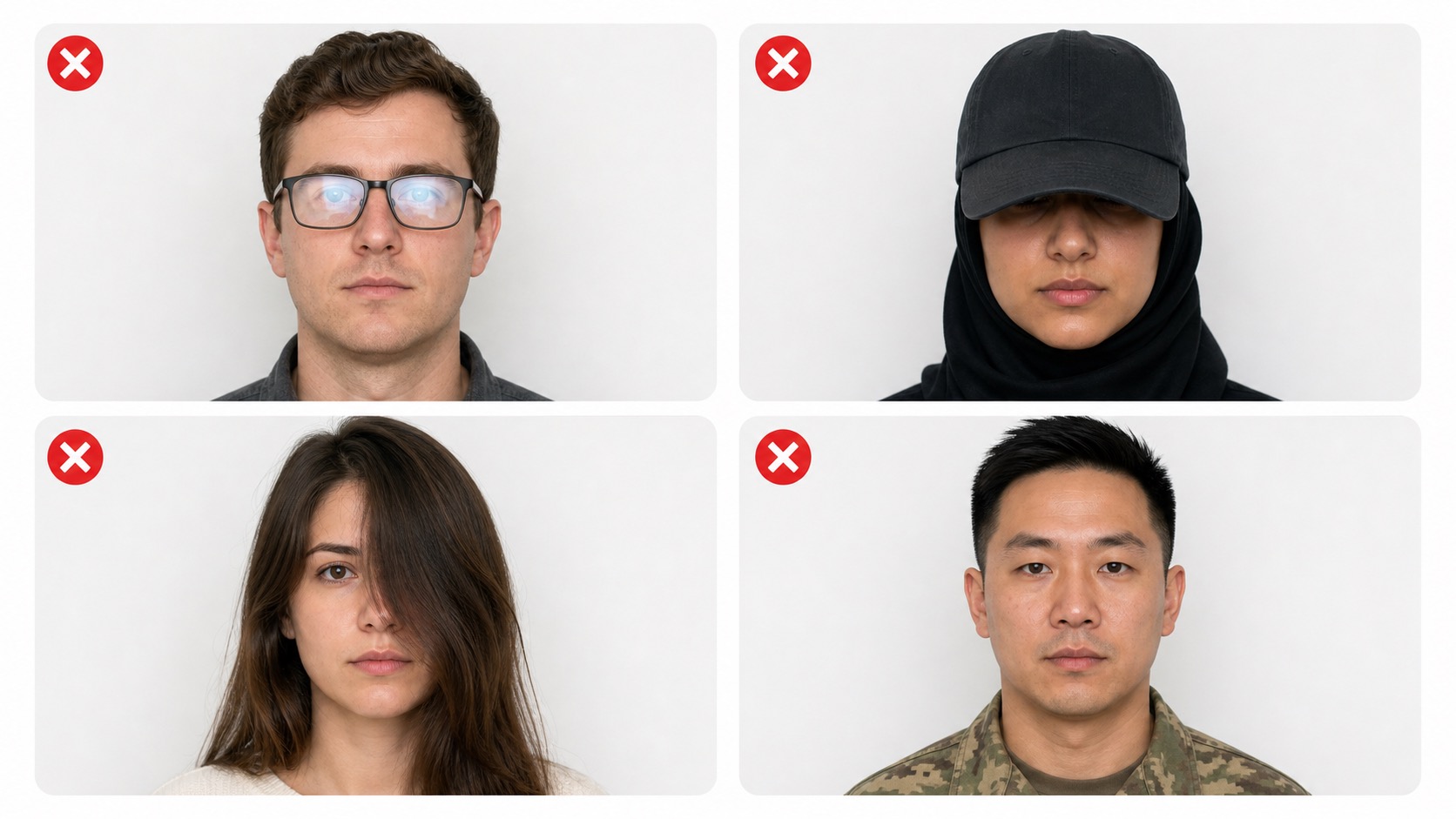
Digital retouching or AI changes
Do not beautify, reshape, filter, or otherwise change your face or appearance.
Wrong head size or position
Photos taken too close, too far away, or off-center may not match the composition template.
Bad lighting or shadows
Overexposure, underexposure, side shadows, and background shadows can obscure your features.
Glasses, hats, or uniforms
Glasses are generally not allowed. Hats or head coverings need a religious or medical exception.
FAQ
U.S. passport photo questions
What size is a U.S. passport photo?
A U.S. passport photo for paper applications should be exactly 2 x 2 inches, or 51 x 51 mm.
How big should my head be in a U.S. passport photo?
For a printed 2 x 2 inch photo, the head should measure 1 inch to 1 3/8 inches from the bottom of the chin to the top of the head, including hair.
Can I use a selfie for a U.S. passport photo?
You can start from a recent portrait, but avoid close wide-angle selfie distortion. Put the camera at eye level, face the lens directly, and keep the final photo centered and correctly sized.
Can I wear glasses in a U.S. passport photo?
The U.S. Department of State says to take off eyeglasses, sunglasses, and tinted glasses unless you have a medical reason and include a signed doctor note.
Can I smile in a U.S. passport photo?
A neutral expression is the safest option. A natural smile can be acceptable if both eyes are open and the mouth is closed.
Can a U.S. passport photo be edited with AI?
Official guidance warns against changing the photo with software, phone apps, filters, or artificial intelligence. Use preparation tools for sizing, cropping, background, and output formatting without altering facial appearance.
What digital size should I use?
The official composition template for digital images uses a square image. Minimum acceptable dimensions are 600 x 600 pixels, and maximum acceptable dimensions are 1200 x 1200 pixels.
References
Official sources
The checklist above is based mainly on U.S. Department of State guidance. The final acceptance decision is always made by the reviewing passport or visa authority.